
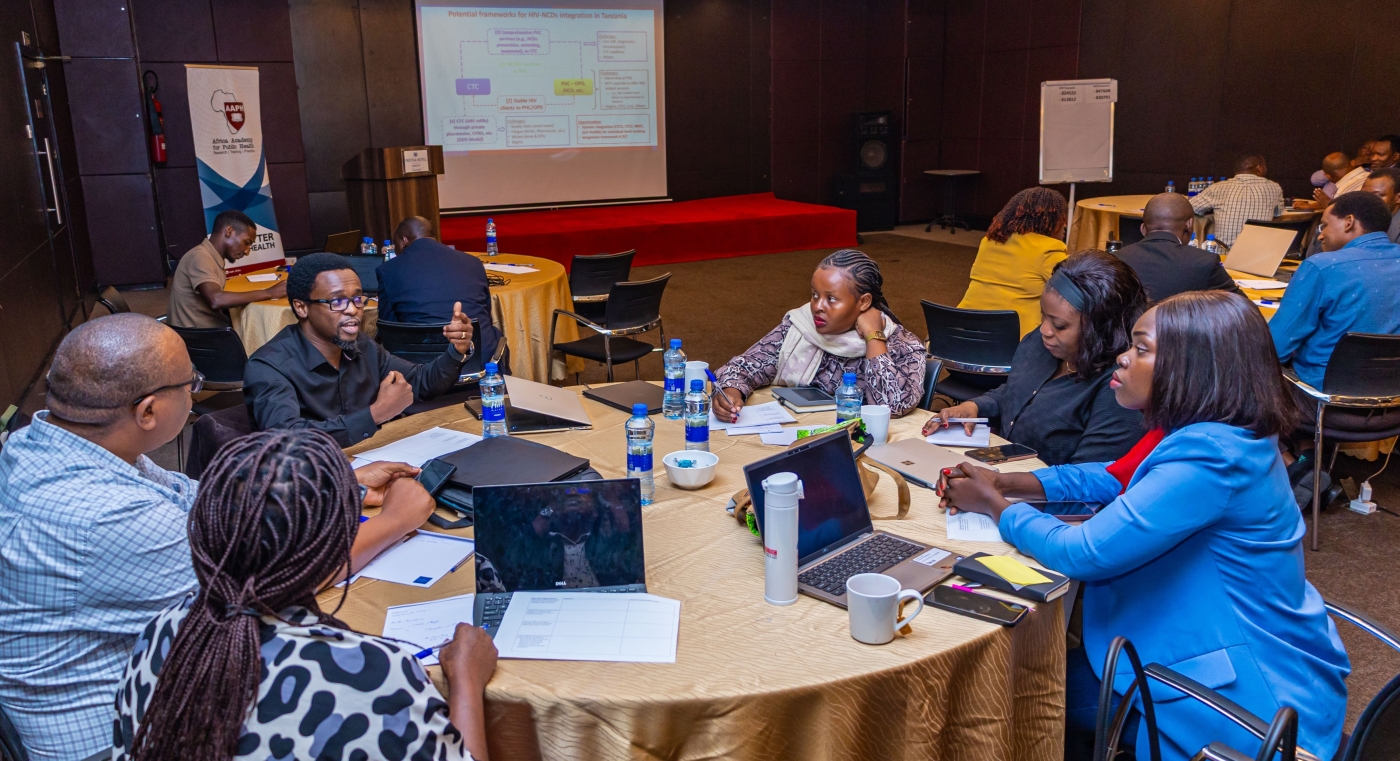
From February 25 to 26 2026, the Africa Academy for Public Health (AAPH) and the National AIDs, STIs and Hepatitis Control Program (NASHCoP) had the great pleasure of organizing a co-creation workshop on the integration of HIV and Non-communicable diseases (NCD) services in Tanzania. This two-day event was hosted at the Protea Courtyard Hotel in Dar es Salaam, convening 50 stakeholders from the Ministry of Health (MoH), Prime Minister’s Office, Regional Administration, and Local Government (PMO-RALG), bilateral partners, donors and HIV Implementing Partners (IPs).
Tanzania is one among many sub-Sahara African countries that can boast in the successful provision of care and treatment services for people living with HIV/AIDS (PLHIV), by meeting the last two UNAIDS 95-95-95 targets ahead of the 2025 goal date. However, recent changes in the funding landscape of global health programs have presented new challenges that could threaten the continued care of these patients. In response, the workshop aimed to continue the overarching discussions on potential mitigation strategies to sustain improvement in healthcare services for PLHIV. One such strategy is the integration of HIV care with other services, such as NCDs commonly reported among PLHIV in Tanzania.
The integration of healthcare services is a crucial milestone to transform existing healthcare models from a vertical disease-centered systems of care to horizontal person-centered models. This could be achieved through strengthening the existing primary health care (PHC) systems, making them more comprehensive, cost-effective and data-driven. AAPH has put forth effort towards supporting the Government of Tanzania in achieving this endeavor via a series of co-creation workshops and mathematical modeling.
The first day of the workshop commenced with presentations by the AAPH Syndemic Modeling project team, the NASHCoP, and IPs, to first provide clarity on the project, align the project with the national HIV services integration agenda, including strategic frameworks and plans, and PHC care pathways. Of note, the MoH, PMO-RALG and NASHCoP were instrumental in providing insights on currently utilized frameworks, identifying existing gaps, and aligning the project to existing national and bilateral priorities on the integration of health services.
On the second day, the stakeholders convened in groups to discuss further on the components of a successful integrated HIV-NCDs - and other services frameworks, including challenges and opportunities. A consensus was reached for a proposed model that seeks to transform HIV services provision through the existing Care and Treatment Centers (CTCs) to Chronic Care Clinics (CCCs) models, where an identified cluster of chronic diseases: HIV/AIDs, hypertension, diabetes, mental health, renal failure, among others, will be provided under one roof within the PHC facilities.
The workshop reaffirmed that successful integration must engage the relevant stakeholders, be data-driven, financially sustainable, operationally realistic within the existing PHC systems, and aligned with national priorities. Together with multidisciplinary and multisectoral stakeholders, the AAPH team will support generation of data-driven insights that will be utilized to pilot an optimal integration plan for HIV-NCD services, capture disease clustering, resources identification and maximization as well as sustainable care delivery framework.